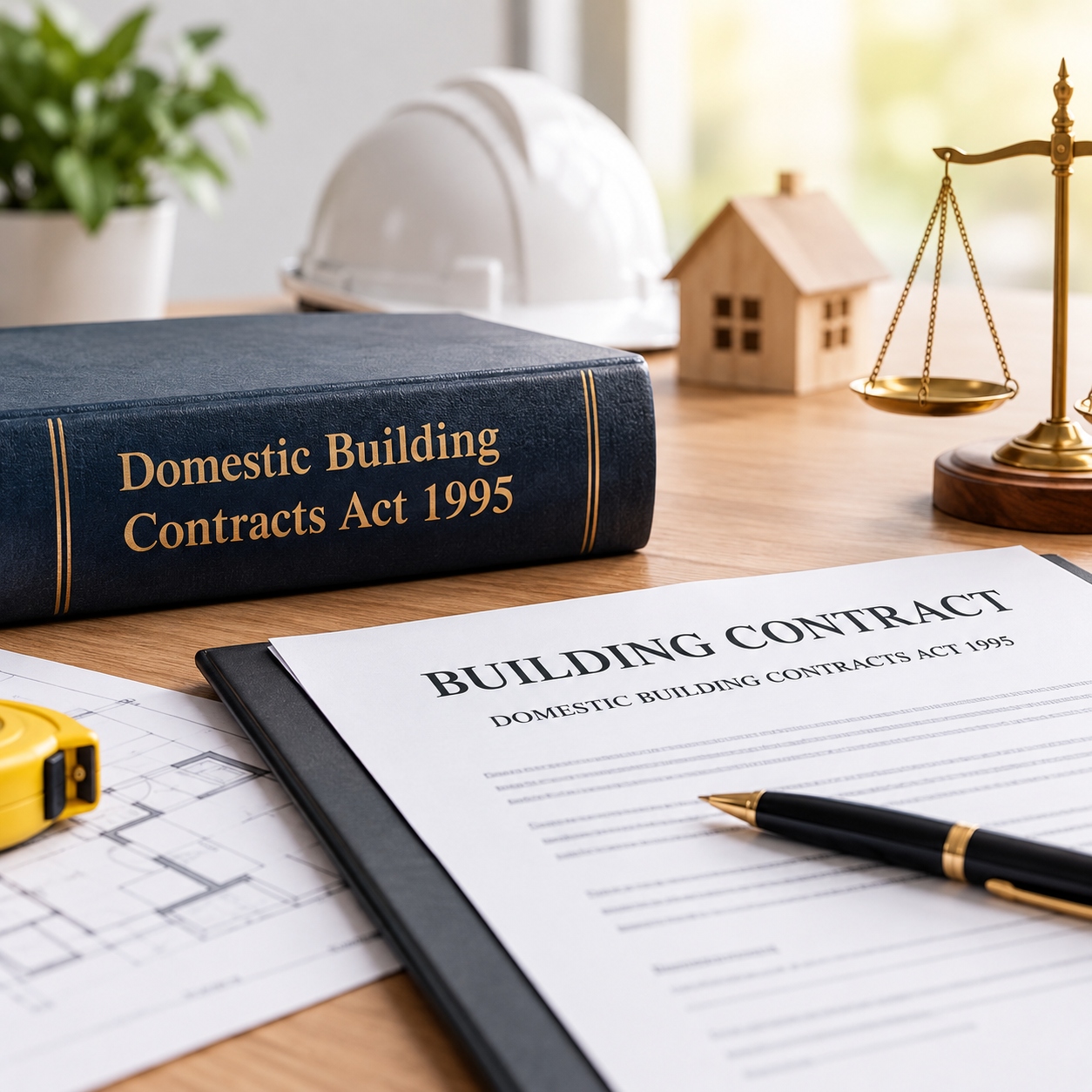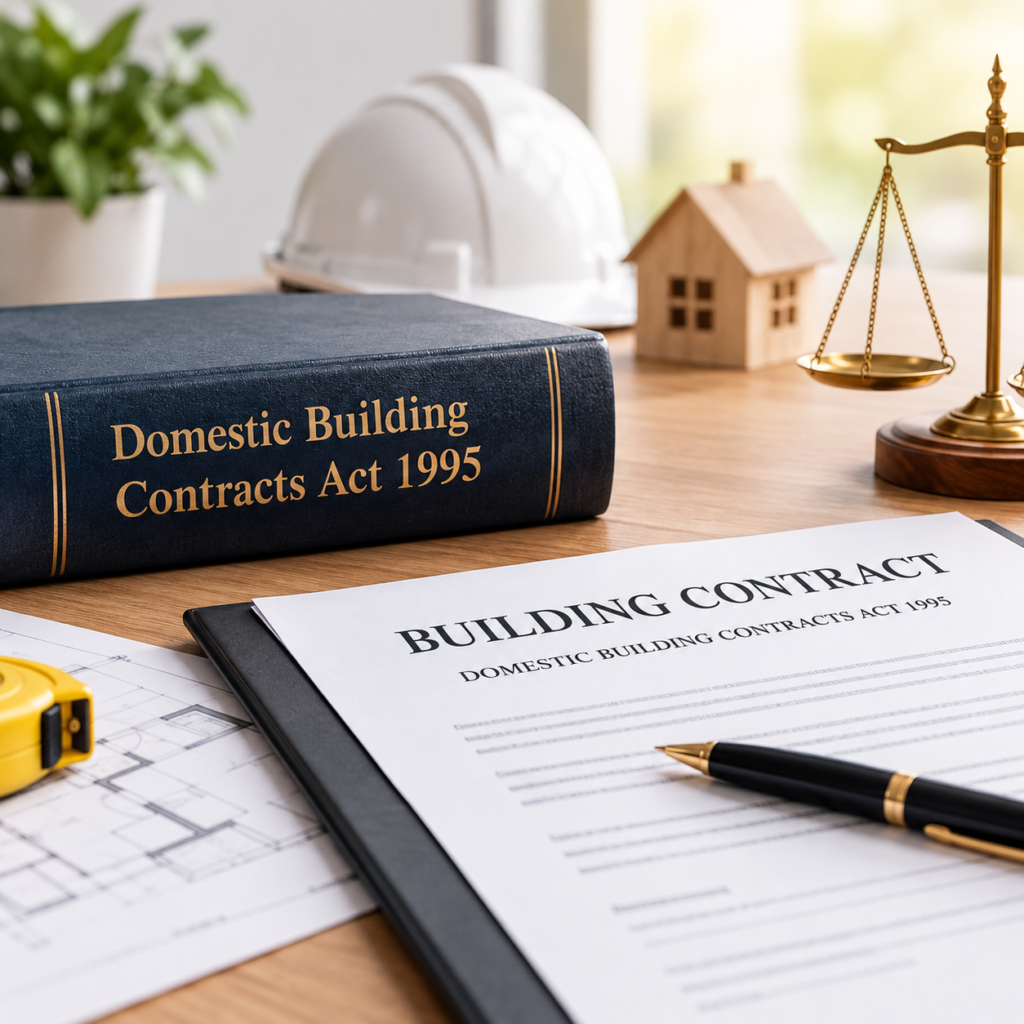
The Domestic Building Contracts Act 1995 is one of the key pieces of Victorian legislation governing domestic building contracts. For builders preparing for Domestic Builder Unlimited registration, understanding the Act is important because it covers practical issues such as contracts, deposits, progress payments, variations, cooling-off rights, warranties and domestic building disputes.
For DBU exam preparation, memorising isolated rules is not enough. You need to understand when a rule applies, what the builder must do, and what happens if the requirements are not followed.
This guide explains the major areas of the Domestic Building Contracts Act 1995 in practical terms and highlights the types of information worth revising for the DBU exam.
Important: Victorian building legislation is changing. The information below reflects the regulatory position in September 2026. Builders should always check the current Victorian legislation and Building and Plumbing Commission guidance before relying on a legal requirement for a live project.
What Is the Domestic Building Contracts Act 1995?
The Domestic Building Contracts Act 1995 is Victorian legislation that regulates domestic building contracts and establishes requirements concerning domestic building work, contractual terms, payments, variations, warranties and dispute resolution.
In practical terms, the Act sets rules for the relationship between a builder and building owner.
It helps answer questions such as:
- When is a major domestic building contract required?
- What information must the contract contain?
- How much deposit can be requested?
- When can progress payments be claimed?
- How can a contract be varied?
- What cooling-off rights apply?
- What warranties apply to domestic building work?
- What happens when a building dispute occurs?
For a Victorian builder, the Act should be considered alongside other requirements, including the Building Act 1993, building regulations, the National Construction Code and Australian Consumer Law.
Why Does the Act Matter to Victorian Builders?
The Act matters because domestic building work is not governed only by the technical requirements for constructing a building.
A builder can complete technically sound work and still face contractual or regulatory problems if the contract, payment process or variations are handled incorrectly.
For example, a builder may need to understand:
Contract: Is a major domestic building contract required?
Deposit: Is the proposed deposit within the legal limit?
Payment: Has the relevant stage actually been completed?
Variation: Has the change been agreed and documented correctly?
Insurance: Does the project require Home Warranty cover?
Dispute: What process should be followed if the owner and builder disagree?
These are exactly the types of practical relationships between legislation and building work that a DBU candidate should understand.
What Is a Major Domestic Building Contract?
A major domestic building contract is generally required for domestic building work covered by the Domestic Building Contracts Act 1995, subject to the type of work, applicable exclusions and other legal requirements.
Examples of domestic building work can include:
- Constructing a new home
- Home extensions
- Renovations
- Alterations
- Repairs and improvements
- Certain landscaping or retaining work associated with domestic building work
For DBU exam preparation, focus on understanding what qualifies as domestic building work, when a major domestic building contract applies, and what requirements the builder must follow.
What Must a Major Domestic Building Contract Include?
A major domestic building contract must contain required information about the parties, work, price and contractual arrangements.
Important information includes:
- names and addresses of the parties
- builder registration details
- contract price
- detailed description of the work
- plans and specifications where applicable
- deposit amount
- progress-payment arrangements
- start and completion information
- delay provisions
- cooling-off information
- relevant warranties
- required notices and approved checklist information
- domestic building insurance or Home Warranty information where applicable.
The contract should describe the work clearly enough that both parties understand what has been agreed.
This is particularly important for fixtures, finishes, materials, specifications and exclusions.
Why this matters for the DBU exam
A common mistake is to study “building contracts” as a single topic.
Instead, separate the topic into:
Contract formation → required information → payment rules → variations → termination → warranties → disputes.
That makes the legislation easier to revise.
How Do Progress Payments Work Under a Victorian Domestic Building Contract?
Progress payments are payments made as defined stages of domestic building work are completed.
The legislation establishes building stages and payment arrangements for relevant contracts.
Common stages include:
- Base
- Frame
- Lock-up
- Fixing
The key concept is:
Payment should correspond with the contractual building stage and the applicable legal requirements.
Before claiming or making a progress payment, the relevant stage should be genuinely complete and the contractual requirements should be satisfied.
DBU exam takeaway
Know the difference between:
- deposit
- progress payment
- completed stage
- final payment
- variation
- prime cost item
- provisional sum.
These concepts can appear similar in practical situations but have different meanings.
How Do Variations Work Under a Domestic Building Contract?
A variation is a change to the agreed building work, plans or specifications.
Variations may arise because:
- the owner requests a change
- an authorised person requires a change
- the original scope needs to be changed in an appropriate circumstance.
The important principle is that variations should not simply be handled through an informal conversation.
For many variations, the change needs to be documented in writing and agreed before the changed work proceeds.
The documentation should identify relevant changes such as:
- what work is changing
- the cost impact
- the revised contract price
- the effect on completion time.
What Are Prime Cost and Provisional Sum Items?
These two terms are important for both real-world building contracts and DBU exam preparation.
Prime cost item
A prime cost item generally relates to a fixture or fitting where the exact item or price has not been determined when the contract is signed.
Examples may include:
- taps
- tiles
- appliances
- door hardware.
The contract contains an allowance, but the owner’s eventual selection may cost more or less.
Provisional sum
A provisional sum is an allowance for work where the builder cannot determine the exact cost when the contract is signed, despite making reasonable enquiries.
What Is the Cooling-Off Period on a Victorian Building Contract?
A building owner generally has five business days after receiving a signed copy of the major domestic building contract to withdraw under the cooling-off provisions.
The starting point is important.
The period runs from when the owner receives the signed copy, not simply from the moment they sign the contract.
There are circumstances in which the cooling-off right does not apply, including situations involving a previous substantially similar contract or where the owner obtained legal advice before signing.
The rules should therefore be studied as a scenario rather than as a single number.
DBU exam takeaway
Remember:
Five business days
But also remember to ask:
When did the owner receive the signed contract?
That distinction can change the answer to a scenario question.
What Happens If There Is a Domestic Building Contract Dispute?
A dispute may arise over:
- defective work
- delays
- variations
- payment
- contract interpretation
- completion
- additional costs
- contractual obligations.
The recommended approach is generally to try to resolve the issue directly first and keep detailed records.
Useful records include:
- the signed contract
- plans
- specifications
- variation notices
- invoices
- payment records
- emails
- written instructions
- photographs
- inspection records.
If the dispute cannot be resolved directly, the parties can use the Building and Plumbing Commission’s dispute-resolution processes, including Domestic Building Dispute Resolution Victoria.
DBU exam takeaway
A builder should understand that dispute resolution is not simply:
“Go straight to court.”
The Victorian framework provides specific dispute-resolution mechanisms that should be understood as part of domestic building compliance.
How Does the Domestic Building Contracts Act Relate to a DBU Licence?
The Domestic Builder Unlimited (DB-U) registration is a Victorian building practitioner registration class administered by the Building and Plumbing Commission.
A DB-U practitioner is responsible for carrying out, managing or arranging all components of domestic building work within the scope of the registration.
The DBU exam is therefore not simply a test of construction techniques.
It also involves knowledge of legislation, contracts, site management and technical standards.
The BPC introduced a new DB-U examination model in 2026. The new single exam replaced the previous face-to-face interview and plan-based exam for the DB-U assessment process.
Is the Domestic Building Contracts Act 1995 on the DBU Exam?
Yes, it is a relevant DBU exam topic.
The BPC confirms that the new DB-U exam is part of the updated registration assessment system. DBUPrep’s current exam-preparation material identifies the Building Act 1993, Domestic Building Contracts Act 1995, progress payments, variations, prime cost and provisional sums, cooling-off periods and penalties within its Building Acts, Regulations & Contracts chapter.
For candidates, that means the Act should be studied as a practical knowledge area rather than simply read from beginning to end.
A useful revision method is to organise it into:
- Contract requirements
- Major domestic building contracts
- Deposits
- Progress payments
- Variations
- Prime cost items
- Provisional sums
- Cooling-off
- Warranties
- Insurance
- Disputes
- Penalties and compliance
2026 Changes Victorian Builders Need to Know
There are two major developments that should be separated when studying the current rules.
Home Warranty started on 1 July 2026
For new eligible domestic building work, Home Warranty replaced the previous Domestic Building Insurance arrangements.
The new scheme generally applies to eligible work above $20,000 for homes and residential buildings up to three storeys.
Contract reforms have a later commencement date
The Domestic Building Contracts Amendment Act 2025 contains substantial reforms involving areas such as:
- contract requirements
- deposits
- progress payments
- variations
- cost escalation
- dispute resolution
- termination rights
- enforcement.
The commencement timetable has subsequently been changed, with the mandatory backstop for the remaining reforms moved to 31 March 2027.
For DBU candidates, this creates an important study habit:
Always identify whether a question relates to the current law or a future reform.
How DBUPrep Can Help You Prepare
Knowing the legislation is one part of preparing for the Domestic Builder Unlimited exam. The next step is practising how that knowledge is tested. DBUPrep‘s DBU Licence Exam Prep resources provide practice questions covering the major DBU subject areas, including Building Acts, Regulations & Contracts. Practice should focus on more than memorising answers.
A good preparation process is:
Learn the rule → understand the reason → solve a scenario → review the explanation → repeat the topic.
This approach helps you recognise how legislation can be applied to practical building situations.
Frequently Asked Questions
What is the Domestic Building Contracts Act 1995?
The Domestic Building Contracts Act 1995 is Victorian legislation governing important aspects of domestic building contracts, including contract requirements, deposits, progress payments, variations, cooling-off provisions, warranties and dispute resolution.
Does a domestic building contract have to be in writing in Victoria?
A written contract is essential for domestic building work, and major domestic building contracts must comply with specific written-contract requirements. For most domestic building work above $10,000, a major domestic building contract is required.
What must be included in a major domestic building contract?
Important information includes the parties’ details, builder registration details, work description, contract price, deposit, progress payments, relevant dates, cooling-off information, warranties and other required notices and documentation.
How much deposit can a builder ask for in Victoria?
Under the current rules, the maximum is generally 10% for contracts below $20,000 and 5% for contracts of $20,000 or more.
How do progress payments work?
Progress payments are linked to completed building stages and the requirements of the contract. Common stages include base, frame, lock-up and fixing.
What happens if there is a dispute over a domestic building contract?
The parties should first attempt to resolve the issue and maintain detailed records. If the dispute cannot be resolved, the Victorian domestic building dispute-resolution process can be used through the Building and Plumbing Commission.
How do you handle a variation under a domestic building contract?
Variations should generally be documented in writing, with the change, cost and relevant completion-date implications clearly recorded. The precise requirements depend on the type and circumstances of the variation.
What is the cooling-off period on a domestic building contract in Victoria?
The cooling-off period is generally five business days after the building owner receives the signed contract, subject to exceptions.
Do builders need domestic building insurance in Victoria?
For new eligible work from 1 July 2026, Home Warranty generally applies to eligible domestic building work valued above $20,000 for homes or residential buildings up to three storeys, subject to eligibility and exclusions. Older contracts may remain under the previous Domestic Building Insurance arrangements.
How long do statutory warranties last on Victorian domestic building work?
Implied warranties apply by law, and Victorian building law generally allows action relating to building work for up to 10 years from completion, subject to the applicable legal requirements.
Is the Domestic Building Contracts Act 1995 relevant to the DBU exam?
Yes. The Act is a relevant area of DBU exam preparation, particularly topics such as contracts, deposits, progress payments, variations, prime cost items, provisional sums and cooling-off periods.
What is the difference between a DBU licence and the Domestic Building Contracts Act?
A DBU registration concerns a builder’s registration and authority to undertake domestic building work. The Domestic Building Contracts Act 1995 governs important contractual and consumer-protection requirements associated with domestic building work.
Key Points for Victorian Builders
The Domestic Building Contracts Act 1995 should be studied as a practical building-law framework rather than as a collection of isolated sections.
For Victorian builders preparing for the DBU exam, concentrate on the relationship between:
contracts → deposits → progress payments → variations → prime costs → provisional sums → cooling-off → warranties → insurance → disputes.
Most importantly, keep your study material current. Victoria’s building and contract framework is changing, and the rules applying to a contract can depend on dates such as 1 July 2026 and the commencement of later legislative reforms.
For exam preparation, combine legislation study with scenario-based practice so that you can recognise the correct rule when it appears in a practical question.